
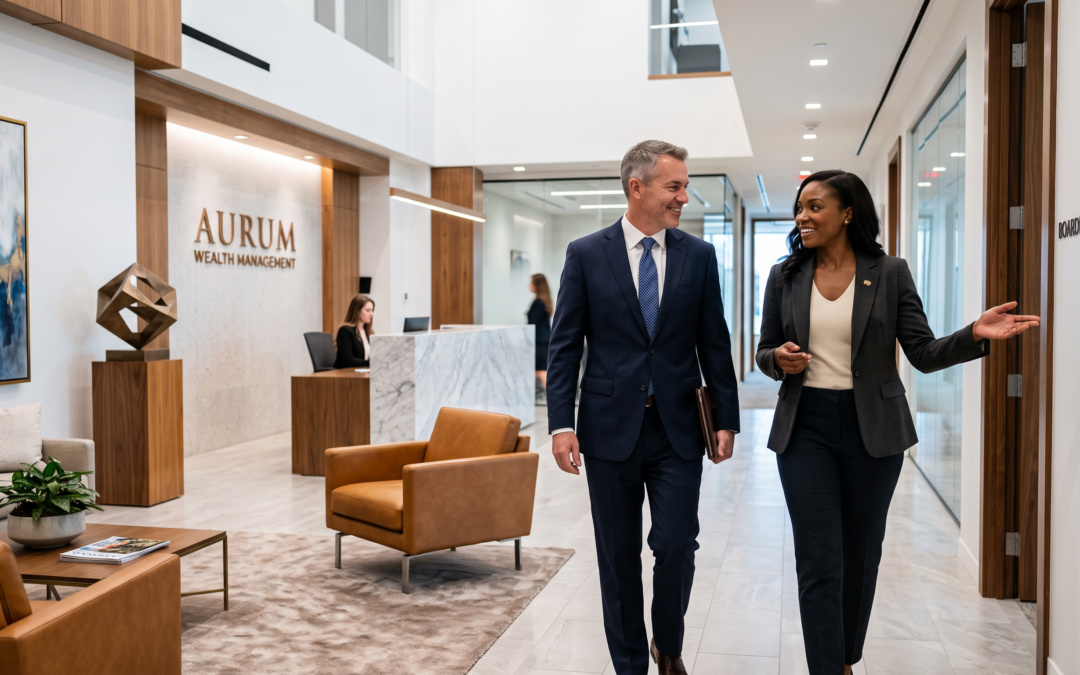
In private equity, investment banking and wealth management, confidence is part of the product. Before a potential investor has heard a presentation, reviewed a financial model or met the investment team, they have already formed an impression of the business.
That impression begins the moment they arrive at the building.
The entrance, reception area, lighting, finishes, furniture, artwork, meeting rooms and even the way a visitor is escorted through the office all contribute to a powerful, often subconscious message: Is this a business I can trust with my money?
For financial services firms managing significant amounts of capital, office interior design therefore needs to do more than create an attractive workplace. It should communicate stability, professionalism, discretion, sophistication and attention to detail. The objective is not to create an office that simply looks expensive. It is to create an environment that makes the firm’s expertise and financial strength feel credible.
The investor journey starts before the meeting
Consider the experience from the perspective of a prospective investor visiting a private equity, investment banking or wealth management firm for the first time.
They arrive at the building, enter the reception area, identify the company, meet the receptionist and are invited to wait. They are then escorted through the office to a boardroom or executive office. Along the way they see the workstations, meeting spaces, offices, finishes and employees.
Every stage of this journey reinforces or weakens their perception of the organisation.
A well-designed financial services office should make the visitor feel that the business is established, organised, successful and capable of managing complexity. Importantly, this does not necessarily require lavish finishes or excessive displays of wealth. In many cases, restraint communicates more confidence than extravagance.
Reception: the first opportunity to establish confidence
The reception area is the physical equivalent of a firm’s opening statement. It should immediately communicate who the company is and the type of business it represents.
For private equity, investment banking and wealth management firms, reception design should generally favour clean architectural lines, high-quality materials and controlled visual branding rather than excessive corporate graphics.
Natural stone or high-quality porcelain surfaces, timber or timber-look architectural finishes, understated metal detailing and carefully selected furniture can create a sophisticated environment without appearing ostentatious.
Lighting is equally important. A combination of architectural lighting, concealed LED illumination and carefully positioned decorative lighting can create depth and highlight important architectural features. Harsh overhead lighting should generally be avoided in areas where visitors are expected to sit and wait.
The reception desk itself should have a strong presence without becoming an oversized feature. A carefully designed desk incorporating stone, timber, glass or metal can establish a sense of permanence and quality.
Branding should be equally considered. A discreet three-dimensional logo or carefully illuminated company name can be far more effective than large printed signage. The message should be confidence rather than advertising.
The waiting experience matters
Visitors should never feel as though they have been placed in an ordinary waiting room.
Comfortable lounge seating, occasional tables, appropriate lighting and carefully selected artwork create a more relaxed environment while maintaining professionalism. Access to refreshments, Wi-Fi and charging facilities can also demonstrate attention to detail.
For wealth management firms in particular, privacy should be considered. Visitors may be discussing sensitive financial matters, so reception seating should avoid unnecessary proximity to other visitors or employees having conversations.
Acoustic control is therefore an important part of office interior design. Acoustic wall panels, upholstered office furniture, carpeting or rugs, ceiling treatments and appropriate spatial separation can help prevent conversations from carrying across the reception area.
The journey from reception to the boardroom
The route from reception to the meeting room is an often-overlooked part of the investor experience.
Rather than treating corridors as leftover space, financial services firms can use them to reinforce their identity and create a sense of progression through the workplace.
High-quality flooring, consistent lighting, architectural wall treatments and carefully selected artwork can turn circulation areas into part of the overall experience. Glass partitions can provide glimpses into the working environment while maintaining appropriate levels of privacy.
The visitor should see a business that appears active, organised and professional. A chaotic office, cluttered desks, exposed cables or poorly maintained furniture can undermine the impression created by an otherwise impressive reception area.
This is why office interior design for investment businesses should consider the entire visitor journey rather than designing individual rooms in isolation.
Designing the boardroom for important decisions
The boardroom is often where the investment decision becomes real. It is where senior executives present investment opportunities, discuss strategy, negotiate transactions and build relationships with clients and investors.
The boardroom should therefore feel authoritative without becoming intimidating.
A substantial boardroom table, high-quality ergonomic chairs, integrated technology and excellent lighting are fundamental. The table should provide sufficient space for laptops, documents and presentation materials without making communication across the room uncomfortable.
Technology should be integrated rather than added as an afterthought. Large professional displays, video-conferencing equipment, concealed cabling, power and data connections should be incorporated into the furniture and architecture wherever possible.
Acoustic performance is particularly important. A boardroom may contain highly confidential financial information, so sound isolation and privacy should be considered alongside visual design.
Materials that communicate quality
Material selection has a surprisingly powerful effect on how a financial services office is perceived.
The objective is to create an environment that feels substantial and durable rather than fashionable for the sake of being fashionable.
- Natural or high-quality engineered stone for reception and feature surfaces
- Timber veneer or premium timber-look finishes for warmth and sophistication
- Quality carpets or commercial flooring that provide acoustic and visual comfort
- Glass partitions to create openness while maintaining professional separation
- Brushed or satin metal detailing for subtle architectural contrast
- Premium upholstered furniture in reception and meeting areas
- Acoustic wall and ceiling treatments where confidentiality and concentration are important
Colour should also be carefully controlled. Neutral architectural palettes with carefully selected darker or natural accents can create an environment that feels established and sophisticated. Strong corporate colours are usually more effective when used selectively rather than covering entire walls or large areas.
Executive offices that support trust and authority
For meetings held in an executive office, the room becomes an extension of the individual and the organisation they represent.
The office should provide a balance between authority and approachability. An oversized desk can create unnecessary physical separation between the executive and visitor. A smaller meeting table or informal seating area can often create a more collaborative environment for investment discussions.
Behind the executive, carefully selected shelving, artwork, architectural features or subtle company branding can establish credibility without appearing staged.
Storage should be integrated wherever possible. Visible paperwork, overflowing shelves and clutter immediately conflict with the perception of precision that financial services firms need to establish.
Privacy and confidentiality are part of the design
Trust is not only about what a visitor sees. It is also about what they experience.
Private equity, investment banking and wealth management firms routinely handle commercially sensitive and highly confidential information. Office interior design should therefore incorporate privacy into the physical environment.
Meeting rooms should have appropriate acoustic separation, while glass partitions may require manifestation, blinds or switchable privacy glass depending on the application. Private offices should be positioned strategically, and circulation routes should prevent visitors from unnecessarily passing through sensitive operational areas.
These details send an important message: this is a business that takes confidentiality seriously.
Furniture choices should reinforce the firm’s positioning
Furniture is one of the most visible investments within an office and can strongly influence how a company is perceived.
For financial services businesses, the priority should be quality, comfort, proportion and consistency. Reception seating should look comfortable and substantial. Boardroom chairs should support long meetings without sacrificing appearance. Desks should provide sufficient working space while maintaining clean lines.
Ergonomic furniture is also important for employees. A firm’s client-facing environment should not come at the expense of the people who spend every day working there.
For offices with hybrid working requirements, flexible furniture solutions can allow meeting areas, collaboration spaces and individual work areas to serve multiple purposes without compromising the executive appearance of the workplace.
Lighting can change the entire perception of an office
Good office lighting is about considerably more than making a workspace bright enough to work in.
Layered lighting can be used to create different experiences throughout the visitor journey. Reception can use softer ambient illumination combined with feature lighting. Corridors can use architectural lighting to create direction and rhythm. Boardrooms require excellent task and presentation lighting, while executive offices benefit from a combination of ambient and focused illumination.
Where possible, natural light should be maximised. Daylight contributes to a more comfortable workplace and can make even a relatively compact office feel considerably more spacious and welcoming.
Art, accessories and the human element
A financial services office should not feel sterile.
Artwork, indoor planting, books, sculptures and carefully selected accessories can introduce personality and warmth while maintaining a sophisticated environment.
The choice of artwork can also communicate something about the firm’s character. South African contemporary art, photography or carefully selected abstract pieces can provide a distinctive identity without resorting to generic corporate imagery.
The key is curation. A few well-chosen pieces will generally have more impact than filling every available wall.
Creating confidence without looking like you are trying too hard
One of the biggest mistakes in designing offices for investment businesses is confusing luxury with credibility.
An office filled with marble, oversized furniture, gold finishes and extravagant decorative elements may communicate wealth, but it can also raise questions about unnecessary expenditure. Investors are looking for evidence of judgement, discipline and competence.
The strongest office interior design therefore often relies on proportion, craftsmanship, material quality, technology, comfort and attention to detail rather than obvious extravagance.
The office should communicate: we are successful, we are disciplined, we understand quality and we pay attention to the details.
Office interior design as part of the investment proposition
No office design can make a poor investment proposition attractive. However, when the business, people and investment opportunity are strong, the physical environment should reinforce that credibility rather than undermine it.
For private equity, investment banking and wealth management firms, the office is effectively a physical expression of the organisation’s brand. Every element, from the reception desk and lighting to the boardroom table, acoustic performance and executive offices contributes to the visitor’s perception of the business.
At SA Office Interiors, we understand that successful office interior design needs to consider more than aesthetics. We combine workplace strategy, space planning, interior design, furniture selection, construction and project management to create professional environments designed around how businesses operate and how their clients experience them.
For a financial services firm, the objective is simple: when a potential investor walks through the door, every element of the environment should reinforce the confidence they need to make an important decision.
