
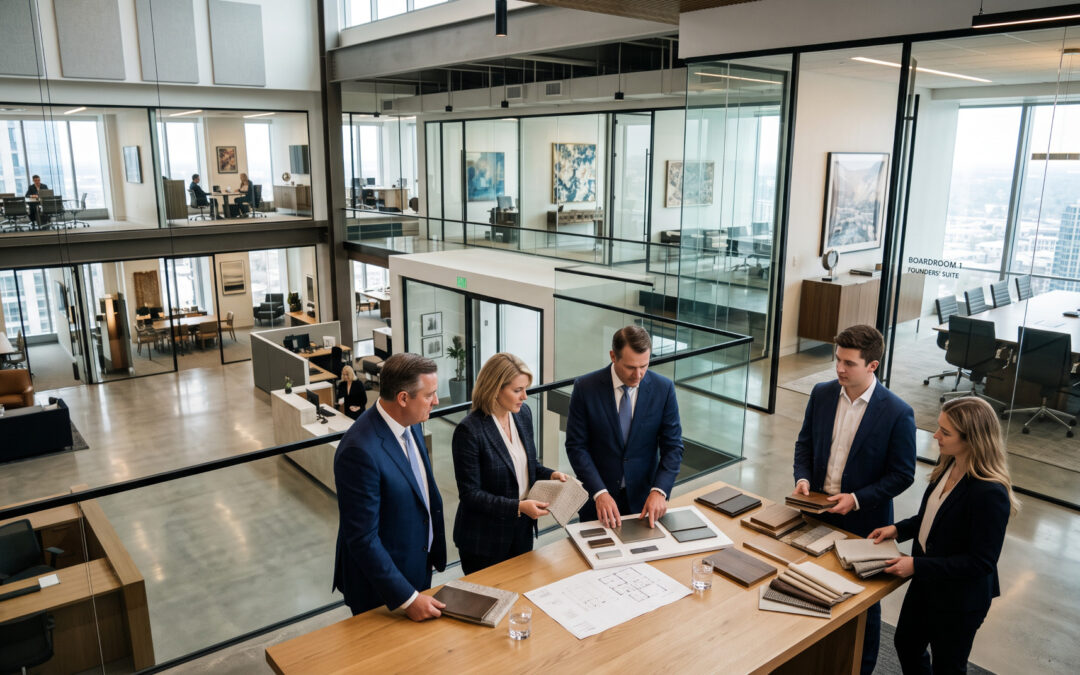
I’ve spent my career designing the top end of the office interior design market, boardrooms for private equity houses, reception areas for luxury brands, executive suites for family offices. And after twenty-plus years in luxury office interior design, I can tell you the single biggest misconception clients bring into that first meeting is this: they think a luxury office is about looking expensive. It isn’t. A luxury office is about looking inevitable. Every material, every sightline, every piece of furniture should feel like there was never another sensible option. That’s the difference between a company that has money and a company that has judgement, and clients can tell the difference within seconds of walking through your door.
This is why luxury office interior designers exist as a distinct discipline, separate from general commercial fit-out. It’s not simply a bigger budget applied to the same brief. It’s a different brief entirely, one built around psychology, perception, and the quiet signals that tell a client or a top candidate exactly what kind of business they’re dealing with before a single word is exchanged.
What Luxury Office Design Actually Communicates
Walk into a beautifully designed executive office and you’re absorbing dozens of micro-signals at once, whether you’re consciously aware of it or not: the weight of a door handle, the quality of light, the acoustic hush of a well-treated boardroom, the fact that nothing looks like it was chosen from a catalogue. Each of these tells a story.
- Competence. Attention to detail in the physical space implies attention to detail in the work. Clients unconsciously extend that assumption to your service.
- Stability. Premium office interiors signal a business that isn’t cutting corners, which matters enormously to clients entrusting you with large sums, sensitive information, or long-term contracts.
- Discretion. High-end office design, done well, whispers rather than shouts. It reassures clients who need confidentiality and calm, not flash.
- Ambition. A considered, premium workspace tells staff and candidates that the business is playing a long game, and that they’re joining something built to last.
This is the real value proposition behind luxury office interior design: it’s a form of communication that operates below conscious notice but shapes decisions anyway, from whether a client signs, to whether a candidate accepts an offer, to whether an investor feels comfortable writing a cheque.
Which Business Types Should Invest in Luxury Office Interior Designers
Not every business needs this level of design. A luxury office fit-out is a strategic investment, and it earns its keep fastest in industries where trust, perceived status, and client confidence are directly tied to revenue. Here’s where I consistently see the return justify the investment.
1. Law Firms and Legal Practices
Clients hiring a law firm, particularly for high-value litigation, M&A, or private client work, are buying reassurance as much as expertise. A beautifully designed reception, a boardroom with genuine gravitas, and private consultation rooms that feel secure and considered all reinforce the sense that this firm handles serious matters seriously. For legal practices competing at the top of the market, premium office interior design isn’t decoration, it’s part of the pitch.
2. Private Equity, Investment Banking and Wealth Management
Few sectors depend on perceived stability and discretion more than finance. Clients handing over significant capital want to feel they’re dealing with permanence and precision. Luxury office design in this space typically leans toward understated materials, natural stone, fine timber veneers, considered lighting, rather than anything ostentatious. The message is quiet confidence, not conspicuous spend.
3. Luxury Retail Head Offices and Brand Headquarters
If your business sells a luxury product or experience, your head office has to embody that same standard internally, not just in-store. Buyers, press, and partners frequently visit corporate offices, and a headquarters that doesn’t match the brand’s retail presentation undermines the very positioning the brand has spent years building.
4. Executive Suites and Boutique Consultancies
Management consultancies, executive search firms, and boutique advisory practices sell judgement and access as their core product. Their offices need to project exclusivity and calibre, often to a very small number of extremely high-value clients per year. In this context, a premium boardroom and considered executive office design directly support the fee levels the business is charging.
5. High-End Medical, Aesthetic and Wellness Clinics
Private healthcare, aesthetic medicine, and premium wellness practices sell trust in a deeply personal context. Clients need to feel safe, discreet, and cared for the moment they arrive. Luxury interior design here does real clinical work, reducing anxiety, reinforcing credibility, and justifying premium pricing against clinics that look purely functional.
6. Luxury Real Estate and Property Investment Firms
Agencies and investment firms selling premium property are, implicitly, selling taste. An office that doesn’t reflect strong design judgement undercuts a firm’s authority to advise clients on multi-million-rand property decisions. This is one of the clearest cases where the office itself functions as a portfolio piece.
7. Family Offices and Private Investment Vehicles
Family offices manage generational wealth and often meet with a small circle of trusted advisors, beneficiaries, and partners. The design brief here tends toward quiet, residential-feeling luxury rather than corporate polish, spaces that feel personal, secure, and enduring rather than transactional.
8. Architecture, Design and Creative Agencies
For firms that sell design expertise directly, the office is the single most credible piece of evidence they can offer a prospective client. An architecture practice or design studio with an unremarkable office is, fairly or not, a harder sell. Here, the workspace has to function as a working portfolio.
The Common Thread
Across every one of these business types, the pattern is the same: the office is doing commercial work, not just housing staff. Whenever a business’s revenue depends on a client’s perception of trust, competence, exclusivity, or taste, luxury office interior design stops being a discretionary expense and becomes a direct extension of the sales process.
The businesses that get this wrong usually fall into one of two traps: either they under-invest and unintentionally signal instability to exactly the clients they most need to impress, or they over-invest in the wrong direction, chasing visible luxury (marble everywhere, oversized branding, ostentatious finishes) rather than the quiet, considered luxury that actually reassures sophisticated clients. The best luxury office interior designers know the difference, and know it changes by industry, by client base, and by what a business is actually trying to signal.
If your business sits in any of the categories above, and your current office doesn’t yet reflect the standard your clients expect, that gap is worth closing. The right luxury office fit-out doesn’t just improve morale or aesthetics, it becomes part of how your business wins and retains the clients it’s built to serve.
