
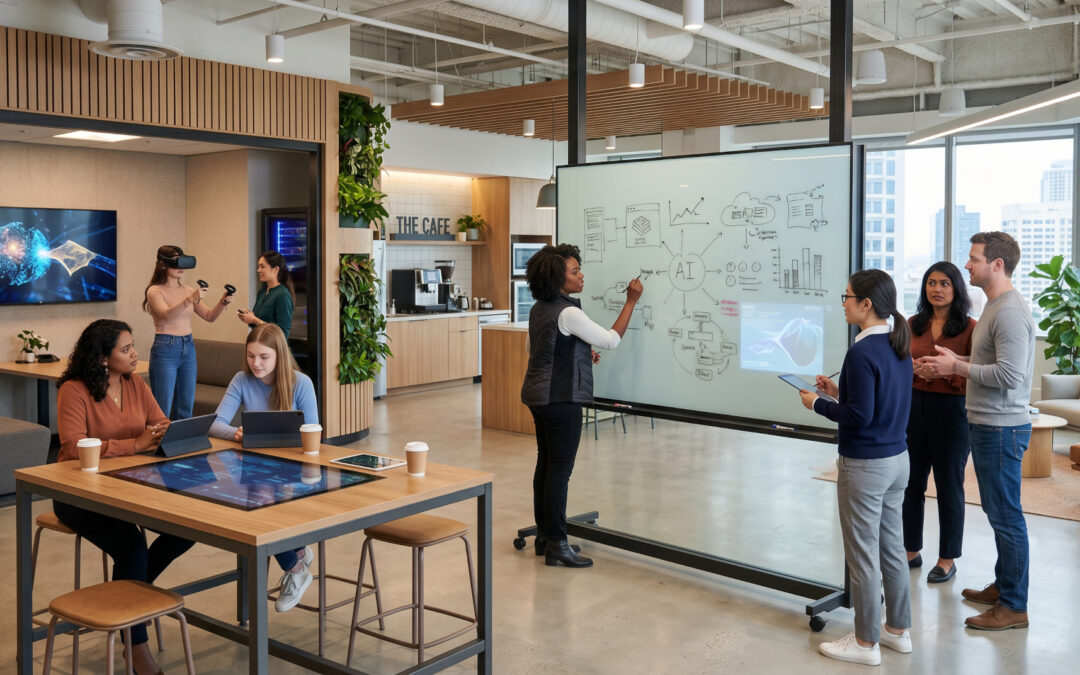
Over the past two decades, office interior design has undergone a remarkable transformation. Not so long ago, most offices consisted of enclosed rooms, long corridors, rows of filing cabinets and fluorescent lighting. Employees worked at the same desk every day, meetings took place in formal boardrooms, and technology was often limited to a desktop computer and a telephone.
Today’s workplace is almost unrecognisable. Open-plan layouts, collaborative spaces, quiet zones, video conferencing facilities, hot desking and hybrid working have completely changed the way offices are designed. The COVID-19 pandemic accelerated this evolution even further, forcing businesses to rethink how employees work together both in the office and remotely.
Now another major shift is taking place. Artificial Intelligence (AI) is changing not only how people work but also how offices need to be designed. Businesses that understand these changes will create workplaces that improve productivity, attract talented employees and remain relevant for many years to come.
The Office is No Longer Just a Place to Work
One of the biggest changes in recent years is that employees no longer come to the office simply to sit behind a computer. Many routine administrative tasks can now be completed from home or even automated using AI software.
Instead, the office has become a destination for collaboration, innovation, problem solving and relationship building. Employees come together to brainstorm ideas, meet clients, participate in training and use specialised technology that may not be available at home.
This change means that office interiors need to support many different ways of working throughout the day rather than providing identical desks for every employee.
Designing for AI-Assisted Work
Artificial Intelligence is rapidly becoming part of everyday business. Staff are using AI tools to write reports, analyse data, generate presentations, manage customer enquiries and automate repetitive tasks.
Rather than replacing employees, AI is allowing them to spend more time on creative thinking, strategic planning and personal interaction. Office design should support these higher-value activities.
Modern office interiors are increasingly incorporating:
- Flexible collaboration spaces for brainstorming and teamwork.
- Private focus rooms for concentrated thinking and AI-assisted research.
- Video conferencing rooms with professional lighting and acoustics.
- Technology hubs for demonstrations and presentations.
- Comfortable informal meeting areas that encourage spontaneous conversations.
The emphasis is shifting away from simply providing desks towards creating environments that support different types of work.
Technology is Becoming Part of the Building
In older offices, technology was often added after construction was complete. Today, technology is integrated into the building from the very beginning.
High-speed wireless networks, smart lighting systems, wireless charging, digital booking systems, intelligent climate control and integrated audio-visual equipment have become standard features in many modern workplaces.
Employees expect to move seamlessly between meeting rooms, collaborative areas and individual workspaces while remaining connected at all times.
Office furniture is also evolving, with desks incorporating power outlets, USB charging, cable management systems and adjustable heights that support healthier working habits. The office furniture landscape is also evolving and is moving toward a rental model where businesses can rent their office furniture and return for upgrades or adapt as technology and requirements change.
Flexibility is More Important Than Ever
The rapid pace of technological change means businesses need offices that can evolve as quickly as their operations do.
Fixed layouts with permanent walls and immovable furniture are gradually giving way to modular solutions that can be reconfigured with minimal disruption.
A growing business may need additional collaboration areas this year and more private offices next year. Flexible office furniture, movable partitions and adaptable meeting spaces allow companies to respond without undertaking major renovations.
Future-proofing an office has become one of the smartest investments a business can make.
Employee Wellness Remains a Top Priority
While AI and technology are transforming the workplace, one thing has not changed. Businesses still depend on healthy, motivated and engaged employees.
Research consistently shows that well-designed office environments improve employee satisfaction, reduce absenteeism and increase productivity.
Modern office design places greater emphasis on:
- Natural daylight wherever possible.
- Ergonomic office furniture.
- Indoor plants and biophilic design.
- Good indoor air quality.
- Acoustic treatments that reduce noise.
- Comfortable breakout and relaxation areas.
- Spaces that encourage movement throughout the day.
As AI handles more routine work, human creativity becomes increasingly valuable. Comfortable employees working in inspiring environments are far more likely to generate innovative ideas.
The Rise of Smart Meeting Spaces
Meetings have changed dramatically over the past few years. Hybrid meetings involving both in-office and remote participants are now common.
Modern meeting rooms require more than a table and chairs. They need integrated cameras, microphones, large displays, wireless presentation systems and reliable internet connectivity.
Good interior design also considers acoustics, lighting and furniture positioning to ensure every participant enjoys an excellent meeting experience regardless of where they are located.
Sustainability Matters More Than Ever
Businesses are becoming increasingly aware of their environmental responsibilities. Office interior design now considers sustainability alongside appearance and functionality.
This includes selecting durable office furniture, energy-efficient lighting, environmentally responsible materials and layouts that maximise natural light while reducing energy consumption.
Sustainable design often lowers operating costs over time while demonstrating a company’s commitment to responsible business practices.
Creating Spaces That Attract Talent
Today’s workforce has higher expectations than previous generations. Employees often compare workplaces in much the same way customers compare products.
An attractive, comfortable and technologically advanced office helps businesses recruit skilled professionals while encouraging existing employees to remain with the company.
Features such as wellness spaces, coffee lounges, collaborative hubs, quiet rooms and flexible work areas demonstrate that a company values its people as much as its profits.
In competitive industries, office design has become an important part of employer branding.
Professional Office Interior Design Makes the Difference
Creating an AI-ready office involves much more than buying new desks or repainting the walls. Every decision affects how employees move through the building, communicate, concentrate and collaborate.
Professional office interior designers carefully evaluate workflows, departmental relationships, future growth, technology requirements, furniture selection, lighting, acoustics and employee wellbeing before developing a comprehensive design solution.
The result is an office that not only looks impressive but also functions efficiently for years to come.
The Future Office is Human-Centred
Ironically, as Artificial Intelligence becomes more powerful, successful office design is becoming increasingly focused on people.
AI can process information faster than any employee, but it cannot replace human creativity, empathy, leadership and collaboration. The modern office exists to bring people together where these uniquely human qualities can flourish.
The offices of the future will be intelligent, flexible, sustainable and highly connected. They will integrate advanced technology seamlessly into everyday work while providing inspiring environments that encourage innovation and support employee wellbeing.
Businesses planning office renovations or relocating to new premises should think beyond today’s requirements. Designing for the AI generation means creating a workplace that can adapt to changing technologies while remaining centred on the people who ultimately drive business success.
A thoughtfully designed office is no longer simply a workplace. It is a strategic business asset that improves productivity, strengthens company culture, attracts talented employees and prepares organisations for the exciting future that Artificial Intelligence is helping to create.
